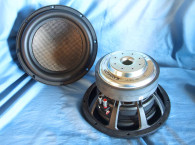


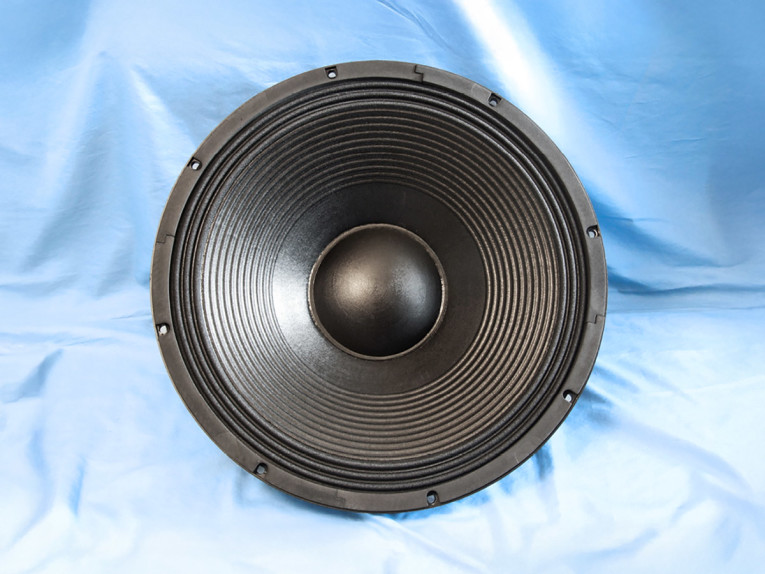
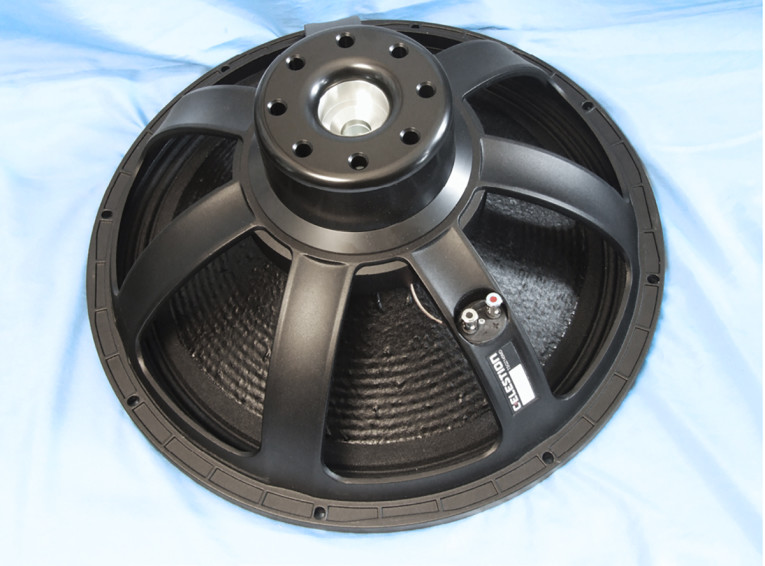
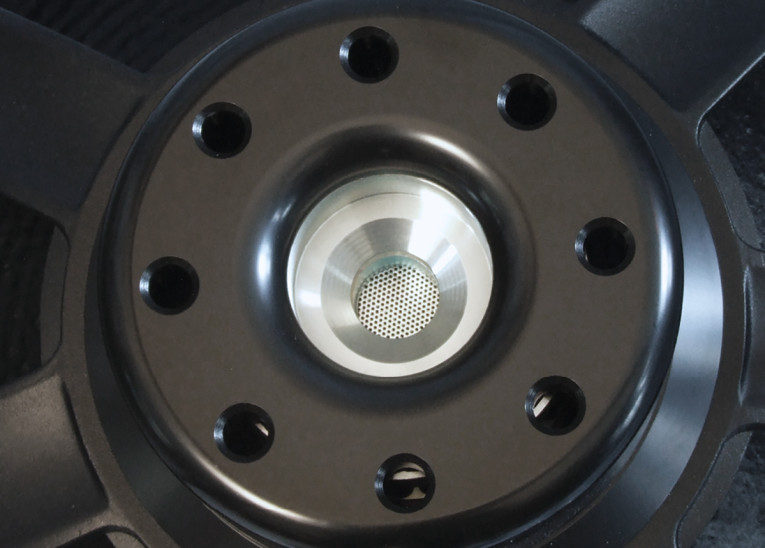
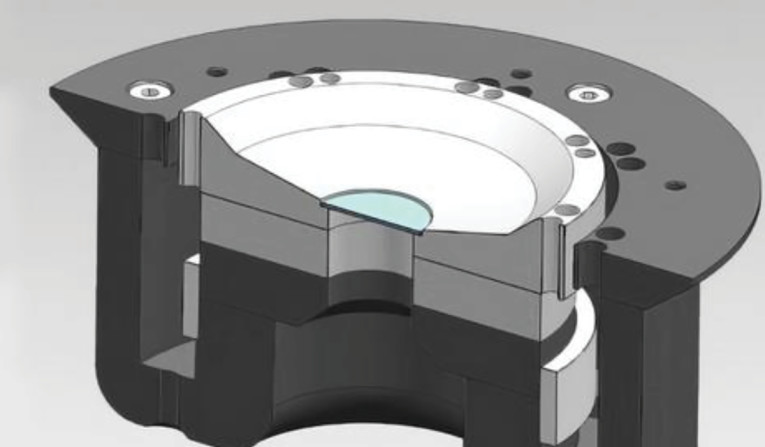
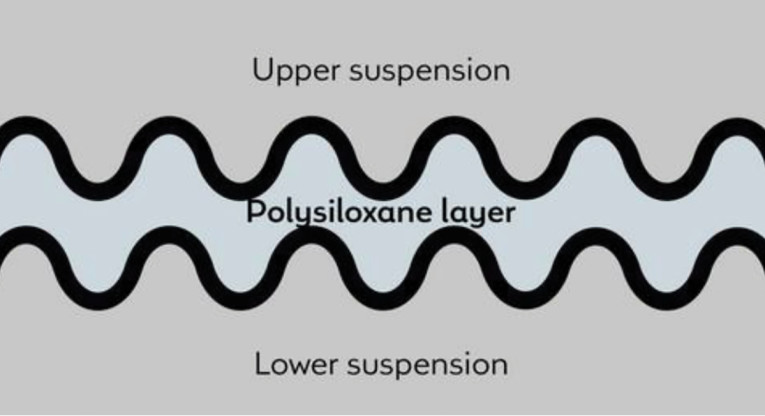
The venting part of this system that is visible can be seen in Photo 4, with a cutaway diagram shown in Photo 5. Here you can see that there are eight 12mm diameter vents placed on the peripheral of the black painted motor return cup, plus a screened 24mm diameter pole vent that opens to flared area then into a 57mm diameter opening.

Factory-rated power handling for this driver is 1800W AES, and 3600W continuous (rated 3dB above the AES rating). Last, the voice coil is terminated into a pair of chrome color-coded push terminals.
I commenced testing of the Celestion TSQ2145 using the legacy LinearX LMS analyzer and VIBox to create both voltage and admittance (current) curves with the driver clamped to a rigid test fixture in free air at 0.3V, 1V, 3V, 6V, 10V, 20V, 30V, and 40V allowing the voice coil to progressively heat up between sweeps with a 200Hz sine wave. Note that the TSQ2145 was still quite linear at 40V and certainly could have been tested at 50V to 60V, but I generally call it quits with high efficiency pro sound drivers at 40V due to the very high SPL in my parameter test room, and that includes wearing hearing protection.
Following my established protocol for Test Bench testing, I no longer use a single added mass measurement and instead use the measured Mmd data (396.2 grams for the Celestion TSQ2145). The 16 550-point stepped sine wave sweeps for each Celestion TSQ2145 sample were post-processed and the voltage curves divided by the current curves to generate impedance curves, with the phase derived using the LMS calculation method. I imported the data, along with the accompanying voltage curves, into the LEAP 5 Enclosure Shop software.
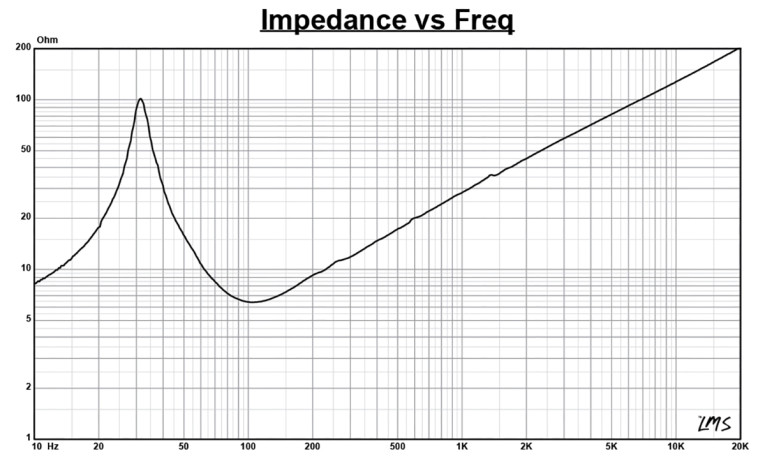
Because Thiele-Small Parameters (TSP) provided by the majority of OEM manufacturers is generated using either the standard model or the LinearX LEAP 4 TSL model, I additionally created a LEAP 4 TSL parameter set using the 1V free-air curves. I selected the complete data set, the multiple voltage impedance curves for the LTD model and the single 1V impedance curve for the TSL model in the Transducer Model Derivation menu in LEAP 5 and created the parameters for the computer box simulations. Figure 1 shows the 1V free-air impedance curve. Table 1 compares the LEAP 5 LTD and TSL data and factory parameters for both TSQ2145 samples.
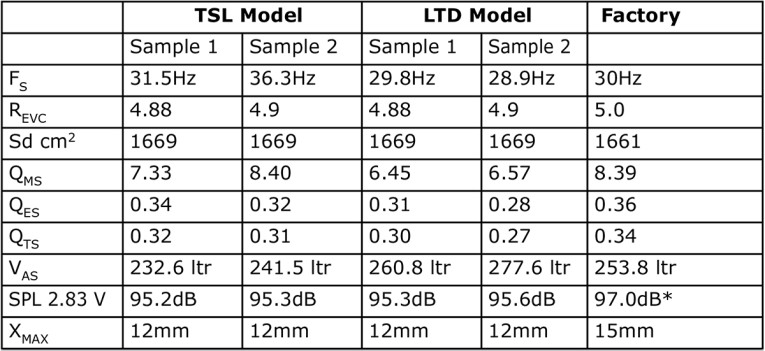
LEAP 5 parameter calculations results for the TSQ2145 correlated well with the Celestion factory datasheet. Note that since the LTD measurements are multi-voltage designed to produce better high voltage excursion curve simulations, I am really only comparing factory TSP to the TSL parameters, which again, in this case look good. Celestion has its own Klippel analyzer, so I assume its TSP are Klippel LPM numbers from the Table of Linear Parameters, which correlates well with the LinearX TSL TSP.
Also, the published coil length and gap height dictate a 12mm Xmax, so the quoted 15mm factory Xmax is, like a lot of other pro sound manufacturers such as Eminence, B&C Speakers, and others, specifically accounting for the gap area fringe field in their Xmax number, which I certainly understand and have no problem with that. Using this somewhat extended formula for physical Xmax is similar to my using Xmax+15% as a maximum excursion criterion.
Following my established measurement protocol, I configured computer enclosure simulations using the LEAP LTD parameters for Sample 1. Celestion doesn’t publish enclosure recommendations, so I set up two computer box simulations into LEAP 5, the first a vented LEAP Extended Bass Shelf (EBS) alignment with a 5.3ft3 volume (15% fill material) tuned to 35Hz and a arbitrarily smaller vented alignment with a 4ft3 volume tuned to 39Hz, also simulated with 15% fiberglass damping material.
Figure 2 displays the results for the Celestion TSQ2145 in the two vented enclosures at 2.83V and at a voltage level sufficiently high enough to increase cone excursion to Xmax+15% (13.8mm for the TSQ2145). This produced an F3 frequency of 31.5Hz (F6=28Hz) for the 5.3ft3 vented alignment and -3dB=35Hz (F6=31.5Hz) for the 4ft3 vented simulation.
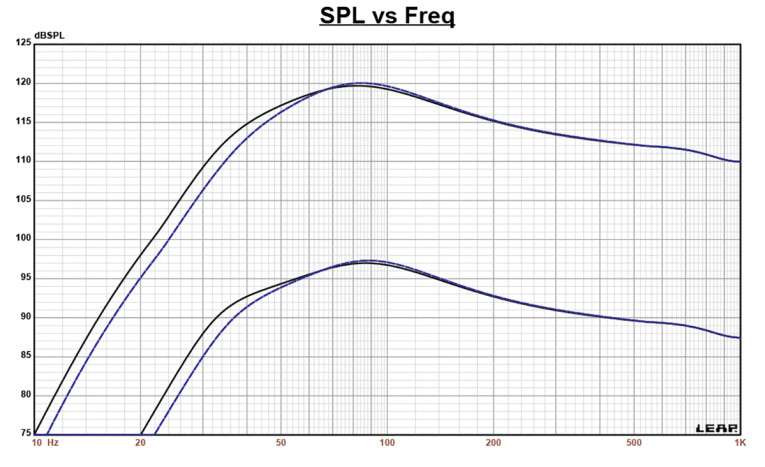
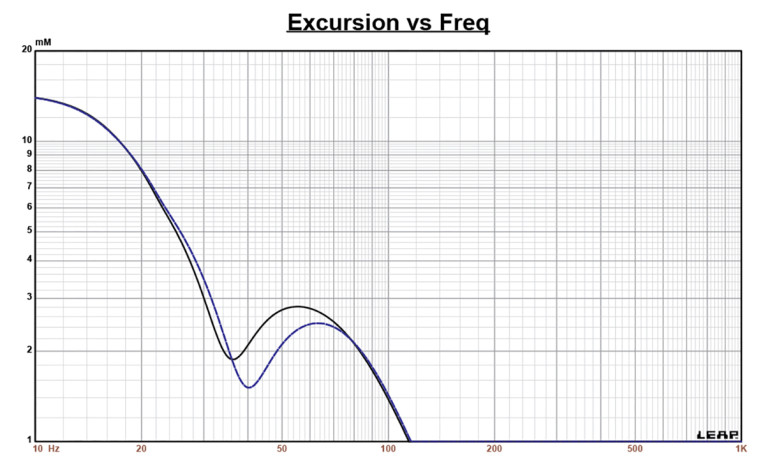
Increasing the voltage input to the simulations until the maximum linear cone excursion was reached resulted in 120dB at 40V for the 4ft3 box and 119.5dB for the same 40V input level for the larger 5.3ft3 vented box. Figure 3 shows the 2.83V group delay curves. Figure 4 shows the 40V excursion curves. Please note that the drivers were excursing to the maximum linear excursion 13.8mm point at 10Hz at 40V, so adding a third- or fourth-order high-pass filter at between 10Hz to 20Hz will decrease excursion and distortion.

Klippel analysis for the Celestion 21” neodymium pro sound woofer is normally provided using our DA2 Klippel analyzer (provided courtesy of Klippel GmbH), and performed by Patrick Turnmire, of Redrock Acoustics, however Patrick was unavailable this month, and since Celestion has its own Klippel analyzer, they graciously provided me with the KBDX files for the TSQ2145, which is what I used to produce the Bl(X), Kms(X), and Bl and Kms symmetry range plots given in Figures 5-8.
The Bl(X) curve for the Celestion TSQ2145 (Figure 5) is very broad and symmetrical with some small amount of coil-in offset. Looking at the Bl symmetry plot (Figure 6), this curve shows a negligible 0.09mm coil-in offset at the 6mm, a point with reasonable certainty, and only 0.36mm coil-in offset at the 12mm physical Xmax position.
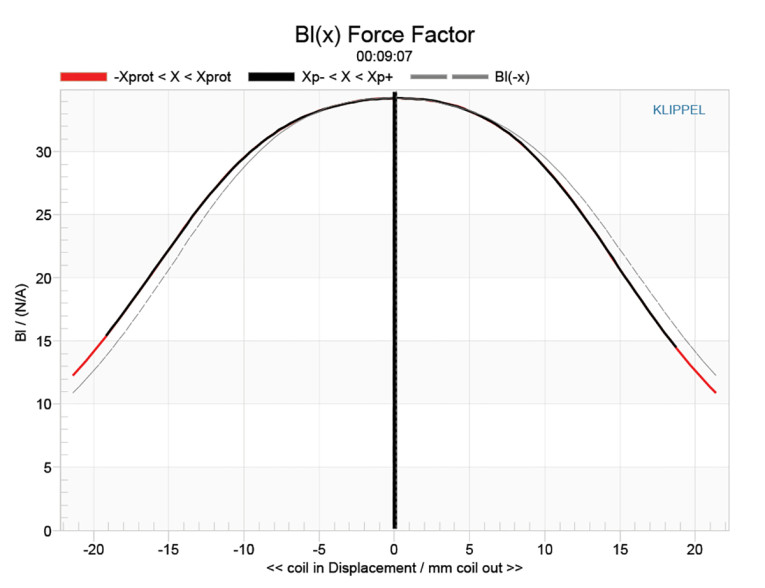
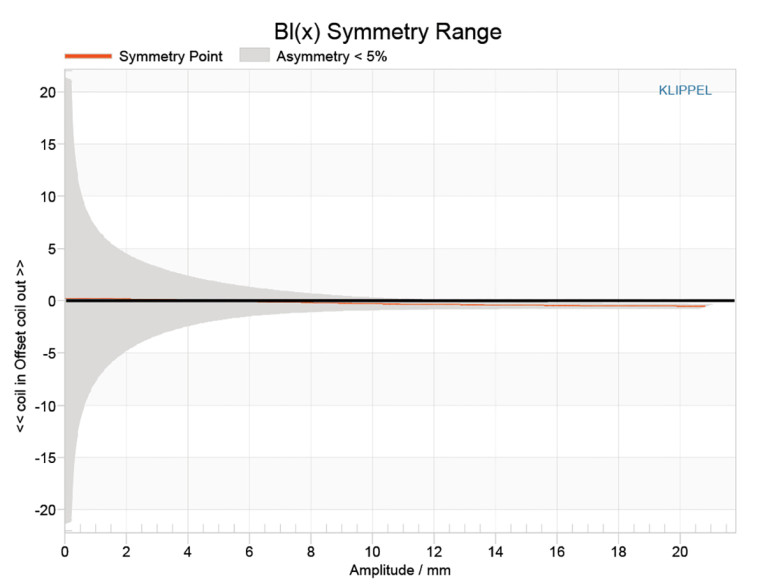
Figure 7 and Figure 8 show the Kms(X) and Kms symmetry range curves for the Celestion TSQ2145. The Kms(X) curve is also mostly symmetrical in both directions also accompanied by an amount of coil-in offset. Looking at the Kms symmetry range plot, the coil-in offset at the same 6.0mm excursion point of the driver is a rather small 0.90mm, decreasing to only 0.54mm at the physical Xmax of the TSQ2145.
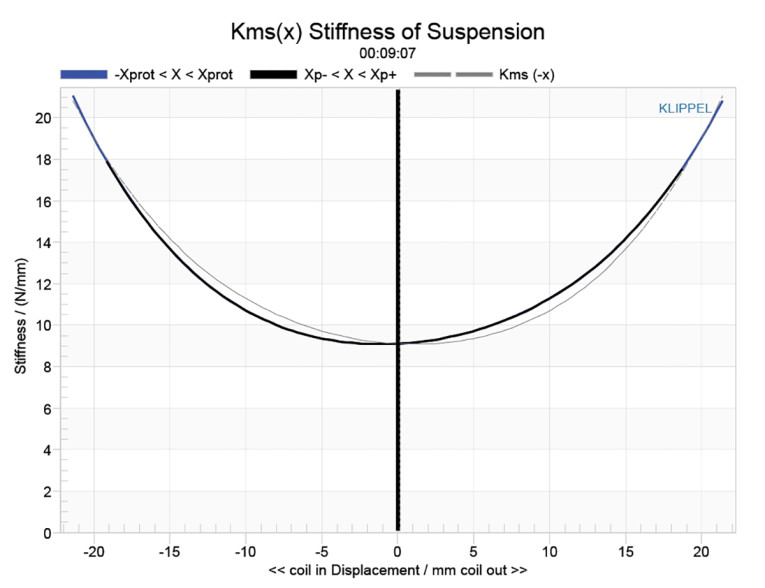
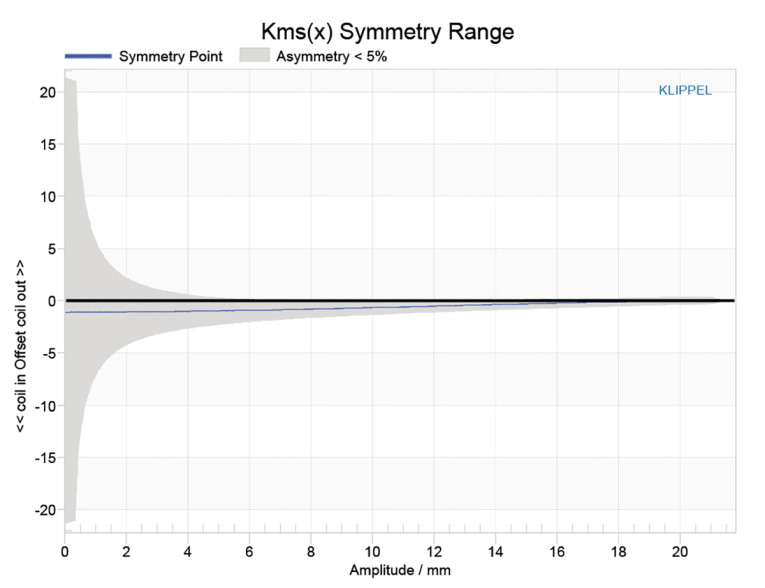
Displacement limiting numbers calculated by the Klippel analyzer for the TSQ2145 were XBl at 70%=13.1mm (1.1mm beyond the physical Xmax) and for XC at 50% Cms was >18.7mm, which means that for this 21” Celestion TSQ2145 the compliance was the dominate contributor for prescribed subwoofer distortion level of 20%. For a 21” woofer, this driver has “excursion for days” as my dear departed friend Chris Strahm (founder of ATI and LinearX, and one of the best loudspeaker, hardware and software engineers in the industry) would have said.
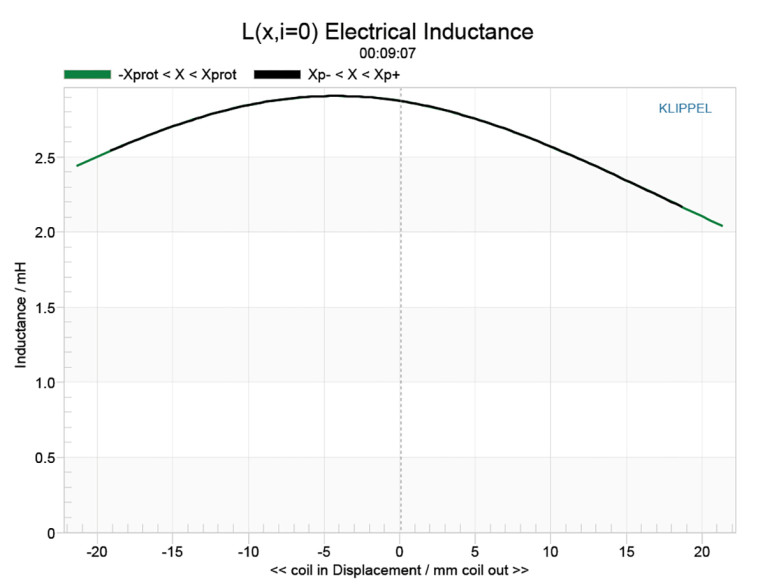
Figure 9 gives the Le(X) inductance curve for the Celestion TSQ2145. Inductance will typically increase in the rear direction from the zero-rest position as the voice coil covers more pole area, which is not what is happening here with the Celestion neodymium motor structure. The inductance swing for this driver is 0.40mH coil-out 0mm to Xmax and 0.12mH coil-in from 0mm to Xmax. This Celestion TSQ2145 shows very low variation in inductance vs. excursion and very good inductive performance.
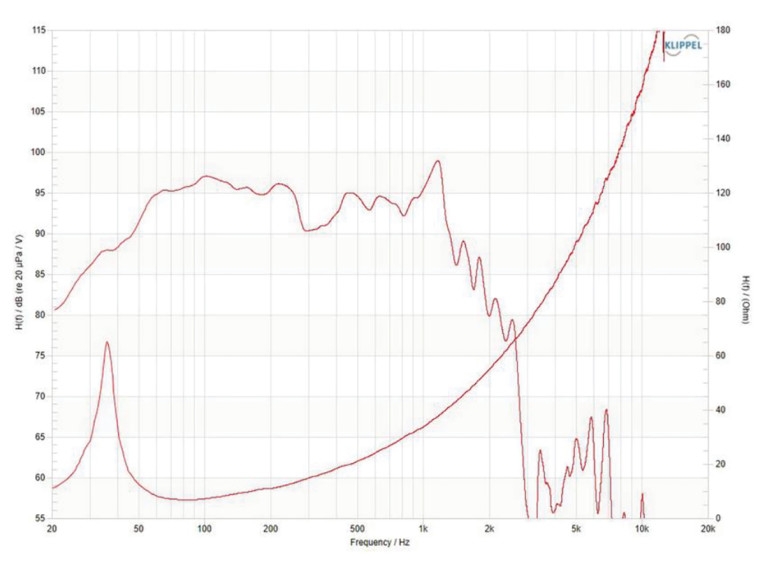
Following the Klippel testing I normally perform on- and off-axis frequency response measurements, however, not for subwoofers, mostly and also because 18” and larger drivers are generally crossed over well below 500Hz where there really isn’t much that is relevant in terms of frequency variation. However, I have included the factory on-axis frequency response (Figure 10).
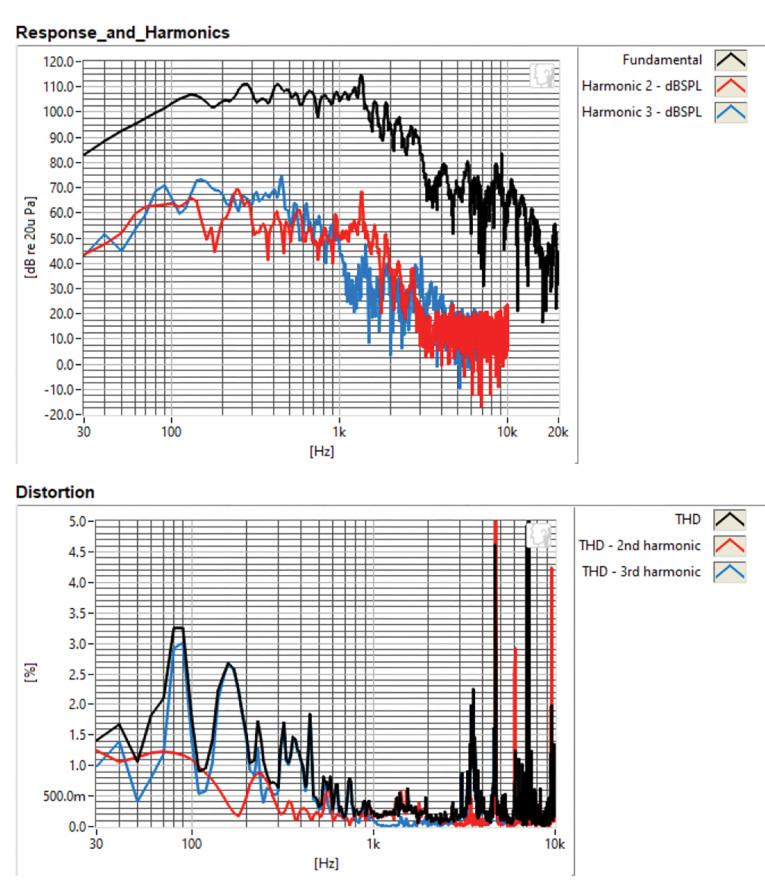
For the last remaining series of tests on the 21” TSQ2145, I employed the Listen SoundCheck AudioConnect analyzer and SCM ¼” microphone (courtesy of my friends at Listen, Inc.) to measure distortion. For the distortion measurement, I mounted the 21” driver rigidly in free air and set the SPL to 104dB at 1m (13.91V), using a pink noise stimulus. Then, I measured the distortion with the Listen microphone placed 10cm from the driver. This produced the distortion curves shown in Figure 11. While I normally follow this with time domain measurements, this information is not particularly useful on subwoofers, so I did not perform the usual SoundCheck time domain cumulative spectral decay (CSD) waterfall and Wignerville surface map plots.
I found this new Celestion TSQ2145 particularly interesting because of the unique cooling technology that is employed. Beyond that, the obviously good objective performance makes this driver an attractive choice in larger PA systems. For more information, visit the Celestion website at www.celestion.com. VC
This article was originally published in Voice Coil, June 2025