


Hearing Beyond Barriers introduces a novel, practical approach based on structure-borne sound acquisition. This technology, branded as Vibrozio, utilizes surface-attached vibration sensors combined with advanced digital signal processing. Vibrozio enables reliable audio capture through a wide variety of solid materials — including glass, metal, plastic, or composites — while maintaining high signal fidelity, even in the presence of ambient noise or acoustic interference on the sensor side.

To commercialize this innovation, Alango Technologies has developed ASAM (Alango Sound Acquisition Module) modules. These compact, scalable, and easily integrable hardware units bring Vibrozio's capabilities into real-world applications. ASAM modules eliminate the need for holes, vents, or external microphones on the other side of the barrier.
From enabling emergency siren detection in vehicles without external microphones to facilitating non-invasive medical monitoring in neonatal incubators and predictive maintenance in industrial environments, this technology also supports tactical applications such as discreet through-window or wall audio monitoring and surveillance in law enforcement, rescue, and military scenarios, where acoustic transparency and stealth are essential.
Representing a significant leap forward in acoustic sensing, Vibrozio technology leverages ASAM modules to enable practical and effective sound acquisition through barriers, opening up previously impossible capabilities across civilian, medical, commercial, and tactical domains.
Foundation
Capturing sound through solid barriers presents a persistent challenge across audio acquisition, sensing, and surveillance domains. Traditional microphones, designed to pick up airborne sound waves, become ineffective when the source is physically separated by materials like glass, metal, or plastic. These barriers block or significantly distort acoustic transmission, severely limiting the ability to monitor, diagnose, or react to acoustic events behind sealed surfaces.
Yet, numerous real-world environments critically demand this capability. Modern vehicles, with their sealed cabin designs and aerodynamic requirements, struggle to acquire external audio using conventional microphones. In neonatal intensive care units (NICUs), sensitive medical monitoring must occur without breaching incubator enclosures. Industrial settings require machinery housed in protective casings to be monitored for faults without physical intrusion. And in tactical operations, covert through-wall audio surveillance can offer critical intelligence without revealing presence.
While using vibration sensors to capture internal sounds through solid surfaces has been known for years, with applications ranging from stethoscopic diagnostics to surveillance, conventional methods suffer from a critical limitation: they indiscriminately pick up all vibrations at the mounting point. This includes vibrations caused by local noise, structural resonances, or mechanical disturbances on the same side of the barrier as the sensor, making it difficult to isolate the signal of interest.
Vibrozio, a proprietary technology developed by Alango Technologies, directly addresses this limitation with a novel signal processing approach. This innovation, currently patent-pending, can discriminate between structure-borne vibrations originating from opposite sides of a surface. This capability enables the system to intelligently reduce unwanted acoustic noises and interferences near the sensor, allowing it to focus on meaningful acoustic signals transmitted through the barrier.
To translate this innovation into practical use, Alango has engineered ASAM (Alango Sound Acquisition Module). ASAM is a compact, surface-mountable module designed to capture structural vibrations with high fidelity. The first generation of ASAM modules do not perform signal processing independently; instead, they serve as the front-end, feeding raw sensor signals to an external, centralized control unit where Vibrozio advanced DSP algorithms are executed. This architecture ensures flexibility, modularity, and optimized performance for diverse real-world deployments across automotive, medical, industrial, and tactical domains.
Depending on the application, the future ASAM modules may additionally include signal analysis, event detection and wireless transmission capabilities.
Structure-Borne Sound and Vibration Sensors
Sound acquisition is fundamentally about capturing vibrations. While airborne sound is familiar, sound also propagates efficiently through solid materials as mechanical vibrations. These structure-borne vibrations carry rich acoustic information, which can be extracted using surface-mounted vibration sensors.
This principle forms the foundation for diverse applications, from stethoscopic auscultation in medicine to contact pickups in musical instruments and basic vibration monitoring. As shown in Figure 1, when airborne sounds encounter a solid surface, they induce these structure-borne vibrations, which can then be converted into electrical signals by a sensor in contact with that surface.

To provide an optimal balance between performance, size, and cost, ASAM modules currently leverage three MEMS vibration sensors enhancing the signal-to-noise ratio (SNR) while maintaining a compact and scalable form factor.
Challenges in Directional Discrimination
Despite the long-standing use of vibration sensors, a major challenge has persisted: their inherent inability to determine the direction of origin of vibrations. Conventional surface sensors capture all motion at the point of contact, regardless of whether it originates from the far side of the barrier (the desired signal) or the near side where the sensor is located (unwanted local interference). As illustrated in Figure 2 in complex environments, this indiscriminately mixes useful signals with irrelevant noise, making it exceedingly difficult to isolate the sounds of interest.
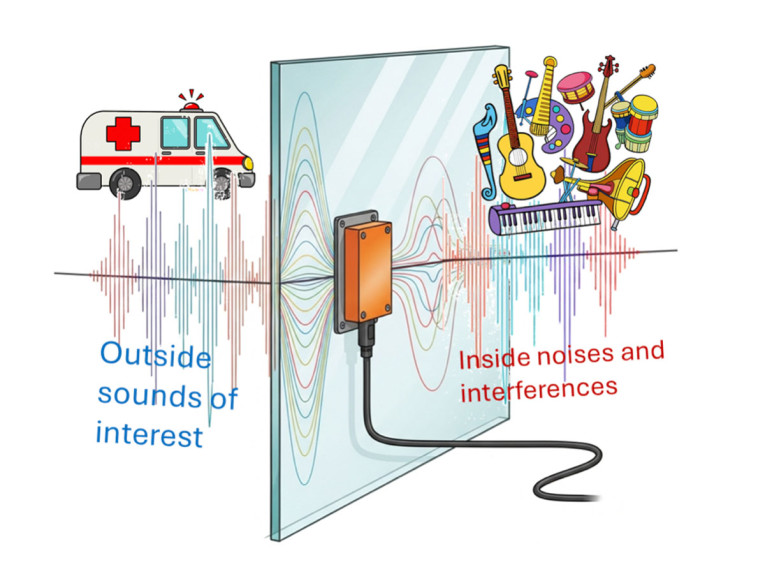
- Automotive: Accurately detecting an approaching emergency vehicle through the window requires suppressing pervasive cabin noise.
- Medical: Monitoring an infant’s cry or breathing from inside a sealed neonatal incubator demands ignoring caregiver speech or equipment noise in the room.
- Industrial: Identifying internal anomalies (e.g., friction, impacts, or leaks) within enclosed machinery must be done without interference from surface vibrations caused by surrounding equipment or human activity.
- Security & Tactical: Covertly listening through walls to detect voices or movement on the opposite side necessitates avoiding false triggers from nearby personnel or environmental noise on the sensor side.
In these critical cases, the inability to distinguish between internal and external vibration sources significantly compromises the effectiveness and reliability of traditional vibration-based systems. Overcoming this directional ambiguity is therefore paramount for high-confidence detection and meaningful signal extraction.
Detecting Sound Origin: Inside vs. Outside
Beyond merely suppressing near-side interference, Vibrozio also addresses the advanced challenge of determining whether a sound, captured by a microphone within an enclosed space, actually originates from inside that space or has merely leaked through the barrier from the outside. This capability is particularly vital in safety, control, and monitoring scenarios where accurately identifying the sound's true origin dictates the appropriate response.
In applications such as vehicle safety systems Vibrozio can reliably distinguish internal cries or movement (e.g., forgotten children or pets as illustrated in Figure 3) from external noises and sounds (such as a conversation near the car). This helps avoid false alarms and enables more dependable occupant detection.

Conventional systems relying solely on microphones or vibration sensors cannot reliably determine this nuanced direction of origin. Vibrozio's innovative combination of structure-borne vibration sensing and reference microphone analysis, augmented by sophisticated directional discrimination algorithms, enables the practical deployment of such critical features without requiring costly or complex multi-sensor arrays.
Alango Sound Acquisition Modules
To bring the revolutionary Vibrozio technology into real-world applications, Alango Technologies has developed the Alango Sound Acquisition Module (ASAM). These compact, modular units are specifically designed to capture both structure-borne vibrations and local acoustic signals for directional sound acquisition through solid barriers.
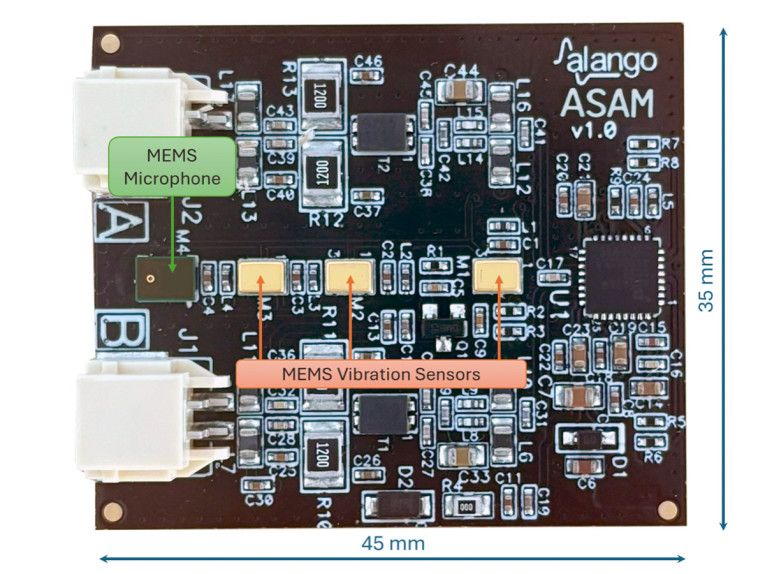
Each ASAM module boasts a physical footprint of just 40 × 35mm and is engineered for easy, non-invasive attachment to flat surfaces such as glass, plastic, or metal using industrial-grade adhesive tape. This streamlined installation ensures reversibility and minimal disruption.
As depicted in the Figure 4, each ASAM module integrates all the essential components. Three MEMS vibration sensors are strategically arranged to optimize signal-to-noise ratio (SNR) and surface coverage. An integrated reference microphone - precisely positioned in close proximity to the vibration sensors - provides the critical acoustic reference for Vibrozio's adaptive filtering.
- Simplified, daisy-chained connection of multiple modules, reducing cabling complexity.
- Remote power delivery from a central control unit.
- Enables highly scalable deployments for various application sizes.
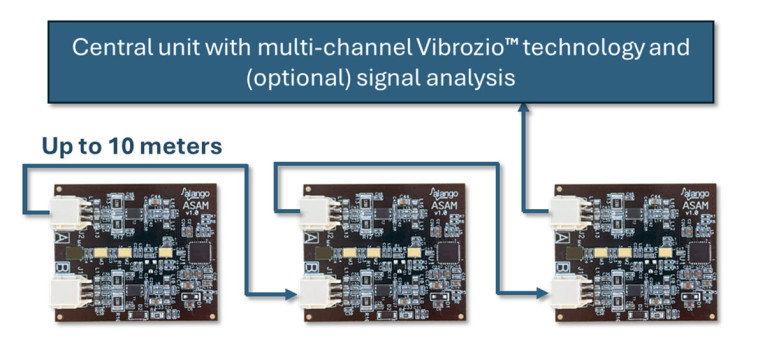
The centralized coordination facilitates unified signal processing, which is particularly valuable when a sound source localization is required. It also simplifies the upgrade path for algorithm improvements via firmware/software updates in the central unit, ensuring long-term adaptability. And ASAM modules also offer the option to record raw signals to non-volatile memory (e.g., flash) for deferred analysis, diagnostics, or forensic purposes.
The Vibrozio Technology
The patent-pending Vibrozio digital signal processing (DSP) technology is the core innovation that enables effective use of vibration sensors for sound acquisition through barriers such as walls, glass, or enclosures. Without it, structure-borne signals captured by the vibration sensors are typically contaminated with unwanted vibrations caused by sounds on the same side as the sensor. These interfering signals such as voices, music, or ambient noise often overlap with the desired signal originating from the opposite side, making it extremely difficult to isolate the sound of interest.
To address this challenge, Alango Technologies developed a novel approach: placing a microphone in close proximity to the vibration sensors to serve as a reference for adaptive filtering. In the ASAM (Alango Sound Acquisition Module) hardware, this microphone is integrated directly into the module, providing a compact and aligned sensor-reference configuration.
Using the microphone as a reference input, Vibrozio applies adaptive filtering to suppress signal components that correspond to acoustic activity on the same side of the barrier as the sensor. This forms the foundational concept of the pending Alango patent, enabling significant reduction of local acoustic interference.
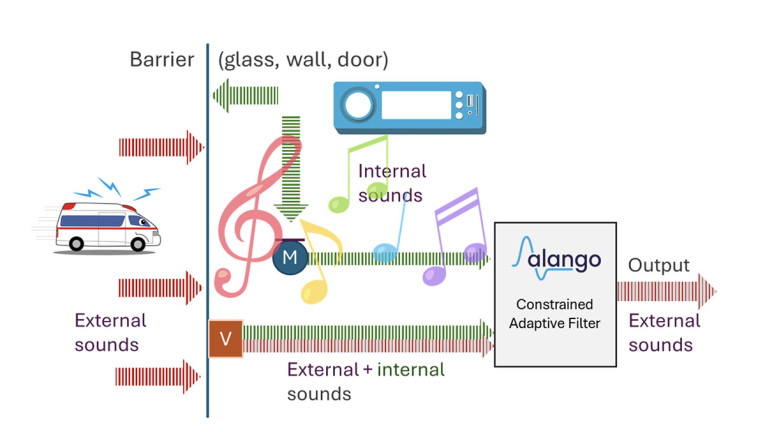
To overcome this, Vibrozio incorporates a proprietary constrained adaptive filtering algorithm. This approach enables effective cancellation of unwanted local acoustic interference without suppressing signal components that correspond to external sounds. In other words, Vibrozio selectively removes only what truly originates from the sensor side of the barrier, while preserving the clarity and integrity of the desired signal from the opposite side.
The mathematical details and implementation specifics of this algorithm are proprietary and outside the scope of this white paper. However, this capability represents a key enabler for practical deployment of vibration-based audio sensing in acoustically complex environments making Vibrozio essential for robust, directional sound acquisition through solid surfaces.
Key Applications
The innovative combination of ASAM hardware and Vibrozio DSP software unlocks a diverse array of practical, high-impact applications across industries where conventional microphones or external acoustic sensors are limited or undesirable. In each of these representative use cases, the ability to detect, isolate, and accurately analyze sound through physical barriers provides a unique and transformative advantage.
Automotive - Modern vehicles increasingly require robust awareness of external audio cues, such as emergency vehicle sirens, traffic signals, or road worker alerts, for advanced driver-assistance systems (ADAS) and autonomous driving. However, integrating microphones on the exterior of a vehicle presents significant challenges related to cost, durability, aesthetics, and maintenance.
By discreetly attaching ASAM modules to interior surfaces of vehicle windows, manufacturers can reliably acquire critical external structure-borne sounds without exposing components to weather, dirt, or vandalism. Combined with Vibrozio's intelligent processing, this approach effectively filters out pervasive internal cabin noise while preserving the integrity and clarity of essential exterior signals.

Voice Interaction in Sealed or Shared Spaces - In environments such as vehicle cabins, smart appliances, or clean rooms, voice-controlled interfaces frequently struggle with accuracy due to the acoustic properties of enclosed spaces or the presence of ambient noise. ASAM modules, integrated with Vibrozio's directional capabilities, allow these systems to reliably determine whether a voice command originates inside or outside a sealed space.
This enables safer and more context-aware control systems — for example, reacting to commands such as "open the window" for voice detected inside the car only, or activating an alert when a user inside the clean room speaks. This enhanced discrimination leads to improved user experience and fewer unintended activations.
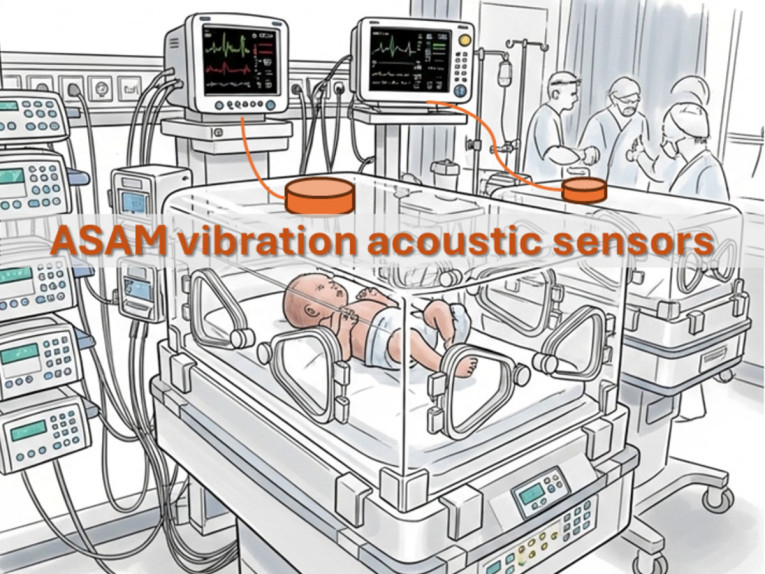
Medical - Many critical medical environments necessitate continuous sound monitoring while maintaining strict sterility, patient isolation, or integrity of enclosed spaces. In such cases, placing microphones directly inside the protected area is either impractical or poses severe safety and hygiene concerns. ASAM modules, mounted on the external surfaces of medical enclosures, provide a non-contact, interference-resistant solution. Vibrozio technology ensures that only internal sounds from the monitored space are captured, while distracting external hospital noise is precisely filtered out.
Key medical use cases include Neonatal Intensive Care Units (NICUs) that are able to monitor infant vocalizations, breathing patterns, and signs of distress without introducing microphones into the sterile environment of an incubator.
Security and Tactical Surveillance - In high-stakes law enforcement, military, or rescue operations, the ability to discreetly hear through walls, windows, or doors without breaching the structure is paramount. ASAM modules attached to surfaces enable covert monitoring while Vibrozio signal processing technology enables clear distinction between conversations or activities occurring inside and outside a monitored room — even in noisy or dynamic environments. This directional awareness provides critical intelligence, enhancing situational assessment and minimizing false positives that could compromise an operation.
Industrial and Others - ASAM modules offer a low-impact, non-intrusive method for monitoring internal machine sounds or detecting structural anomalies without requiring the opening of protective enclosures or direct contact with moving parts. This capability is particularly valuable in predictive maintenance programs, where the early detection of subtle internal rattling, friction, impacts, or fluid flow disruptions can prevent costly equipment failures, reduce downtime, and extend asset lifespan. Vibrozio significantly enhances the utility of this approach by suppressing ambient industrial noise that would otherwise mask these crucial, subtle diagnostic signals.
ASAM's advanced capability to pick up subtle internal vibrations through solid barriers also enables non-invasive pest detection within walls, floors, ceilings, and other enclosed structural elements. By identifying characteristic movement, gnawing, or scratching sounds unique to pests (e.g., rodents, termites, other insects), the system allows for early intervention and targeted remediation. Furthermore, by utilizing several chained ASAM modules, the system gains the ability to precisely localize the source of these acoustic activities, allowing for accurate pinpointing of pest nests or points of entry within structures without destructive inspection. This minimizes damage and facilitates timely, targeted pest management strategies.
Future Outlook
The current generation of ASAM modules, combined with the Vibrozio DSP platform, already delivers a transformative capability for directional sound acquisition through barriers. However, the architecture has been deliberately designed with extensibility in mind, paving the way for a dynamic roadmap of future developments that will significantly expand application scope, increase autonomy, and enhance intelligence.
Future iterations of ASAM will be precisely customized and optimized for targeted use cases, enabling even greater performance and seamless integration. This includes automotive-grade modules specifically optimized for vehicle windows and harsh environmental conditions, medical-grade versions featuring biocompatible enclosures and certifications suitable for clinical environments, and industrial variants meticulously tuned for specific material surfaces or critical mechanical frequencies relevant to machinery monitoring.
This specialized approach will allow for further enhanced performance, greater reliability, and easier certification in highly regulated environments.

Next-generation ASAM modules may integrate local DSP capabilities directly onto the device, shifting some processing intelligence closer to the source. This integration will enable autonomous problem identification, such as on-device detection of mechanical anomalies, distress sounds, or specific voice commands. On-device classification of acoustic events also significantly reduces the volume of raw data transmission and lowering latency for critical alerts. Other options might include multi-modal fusion with other integrated sensors (e.g., temperature, vibration, pressure) for more comprehensive diagnostics and environmental awareness.
Future ASAM modules will also support advanced wireless transmission of processed and filtered audio, revolutionizing deployment flexibility and real-time access. This will allow for simplified, rapid deployment in temporary or retrofit installations, eliminating the need for extensive wiring. These wireless modules will be designed to be battery-powered, enabling effortless installation in locations without pre-existing infrastructure or convenient access to wired power.
The full Vibrozio Technology white paper can be downloaded here.
About Alango Technologies
Alango Technologies Ltd. is a privately held Israeli company renowned for its specialization in advanced digital signal processing (DSP) technologies for voice, audio, and hearing enhancement. Established in 2002, Alango has since developed one of the industry’s most comprehensive portfolios of embedded DSP software, successfully powering over 75 million devices across the automotive, consumer electronics, telecommunications, and assistive hearing markets worldwide. For more information , visit www.alango.com